Ohio Political Fundraising Heats Up |
|
|---|
|
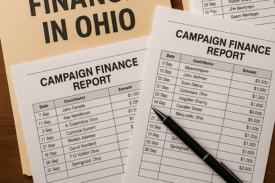 |
Republican Vivek Ramaswamy continues to outpace Democrat Amy Acton in fundraising in the race for Ohio governor. In the most recent reporting period, Ramaswamy raised $9.8 million, nearly triple the $3.9 million reported by Acton. The first-time GOP candidate raised nearly $19.6 million in 2025, more than any gubernatorial hopeful in state history within a single year. For context, Gov. Mike DeWine raised $28 million across his entire 2018 cycle, while Democrat Richard Cordray pulled in $17 million. Ramaswamy reported approximately $13 million cash on hand, far exceeding Acton’s $3 million balance. Fundraising totals in other statewide races favor Republicans as well: Attorney General: - Republican State Auditor Keith Faber reported $500,000 raised and $2.3 million cash on hand.
- Democrat John Kulewicz raised $436,000 and reported $353,000 on hand, while primary opponent Elliot Forhan reported $54,000 raised with $50,800 on hand.
Secretary of State: - Republican Treasurer Robert Sprague raised over $507,000 and held more than $1.8 million on hand.
- Fellow Republican Marcell Strbich reported $210,546 raised with $667,996 on hand.
- On the Democratic side, Bryan Hambley led in funds raised with $303,000 to State Rep. Allison Russo’s $265,000, with Hambley reporting $545,918 on hand to Russo’s $192,459.
Treasurer: - Republican Sen. Kristina Roegner reported $2.4 million on hand with about $450,000 raised;
- Former Rep. Jay Edwards had $1.3 million on hand after raising $836,000.
Auditor - Republican Secretary of State Frank LaRose reported $400,000 in contributions with $808,000 on hand.
- Democrat Annette Blackwell launched her campaign after the January filing deadline so fundraising numbers are available.
Only in the U.S. Senate race does the Democrat candidate have an advantage. Former Senator Sherrod Brown raised $7.3 million while Republican incumbent Jon Husted raised just over $1.5 million during the same period. Brown’s campaign reported nearly $10 million in cash on hand, compared with Husted’s with just under $6 million. |
|
|---|
|
 Fundraising advantages draw attention because they help define early campaign capacity, but financial strength at this stage does not guarantee electoral success. At least at the top of the ticket—Governor and US Senate races—both sides will have ample funds to get their message out in the fall. Fundraising advantages draw attention because they help define early campaign capacity, but financial strength at this stage does not guarantee electoral success. At least at the top of the ticket—Governor and US Senate races—both sides will have ample funds to get their message out in the fall. |
|
|---|
|
Ohio Senate Tax Writers Sets Modest Agenda for 2026 |
|
|---|
|
After a busy 2025 focused on moving Ohio closer to a flat income tax rate and significant property tax reforms, the Ohio Senate Ways & Means Committee has a narrower focus for 2026. With 29 bills pending before the panel, committee leadership made clear last week that procedural matters will take priority over sweeping tax reforms. The committee's early agenda will center on clearing a backlog of bills awaiting first hearings and those carrying minimal fiscal impact in the $100,000 to $200,000 range. Bills Likely to See Movement: - SB 284 – Waives penalties when no tax is due
- SB 285 – Exempts certain conservation lands from CAUV recoupment fees
- HB 148 – Tax refund designation for pet spay/neuter services; limited fiscal impact expected
What's Off the Table: - New spending bills with significant appropriations or state costs
- Major property tax reform; SB 275's partial deferral proposal for eligible homeowners may stall amid lingering fatigue from 2025's heavy legislative lift on the issue
- Standalone action on tips and overtime tax conformity; while SB 9 passed unanimously last year, questions remain about the scope of Ohio's conformity with federal tax changes
|
|
|---|
|
 The theme is restraint. After the aggressive 2025 agenda, the Senate tax writing panel is pressing pause on big-ticket tax policy. Expect technical fixes and lower-profile cleanup bills to define the coming months—a clear acknowledgment of both limited political appetite and fiscal caution as Ohio heads toward another election cycle. The theme is restraint. After the aggressive 2025 agenda, the Senate tax writing panel is pressing pause on big-ticket tax policy. Expect technical fixes and lower-profile cleanup bills to define the coming months—a clear acknowledgment of both limited political appetite and fiscal caution as Ohio heads toward another election cycle. |
|
|---|
|
| Property Tax Repeal Proposal Could Force Sales Tax to 20% |
|
|---|
|
A constitutional amendment to eliminate property taxes that may appear on the November ballot raises serious questions about how the state would fund essential services if passed. Property taxes generate more than $23 billion annually to fund local governments, K-12 schools, police and fire departments, courts, jails, and libraries across every Ohio community. Even with severe budget reductions, Ohio policymakers would face an impossible choice—dramatically raising sales or income taxes—to backfill the loss of property tax revenue. Ohio's income tax could jump to the highest in the country, and Governor DeWine has cautioned that Ohio's sales tax could jump to 20%, nearly triple the current statewide average. While supporters say the measure is needed relief for homeowners facing rising property assessments, critics counter that without a viable replacement plan, the proposal would create fiscal chaos and simply shift tax burdens rather than reducing them. To make the November ballot, supporters must collect at least 413,487 valid signatures from 44 of Ohio’s 88 counties by July 1, 2026. |
|
|---|
|
 Tax reform requires more than frustration — it demands a workable plan. Property taxes provide funding for essential services, and replacing them with higher sales or income taxes could be more regressive and volatile. Repeal without a clear replacement framework risks major disruption to schools, public safety, and community services statewide. Tax reform requires more than frustration — it demands a workable plan. Property taxes provide funding for essential services, and replacing them with higher sales or income taxes could be more regressive and volatile. Repeal without a clear replacement framework risks major disruption to schools, public safety, and community services statewide. |
|
|---|
|
Senate Democrats Unveil Data Center Legislative Package |
|
|---|
|
Ohio Senate Democrats unveiled a legislative package last week aimed at data center development, but the bills face long odds in a GOP controlled Statehouse where the GOP has its own ideas about how to proceed. Senate Democratic leaders outlined proposals targeting reliability, affordability, water use, and local control. The move comes as Ohio hosts nearly 200 data centers, and public concerns over rising electricity costs and strained infrastructure continue to mount. What's in the Democrat package: - Data Center Grid Cost Responsibility Act – Requires data centers to cover full infrastructure costs.
- Data Center Tax Break Bill – Ends new sales tax exemptions for data centers.
- Powering Ohio Communities Act – Conditions grid connection on local investment.
- Local Development Protection Act – Affirms local government authority over development decisions.
- Home Rule Resolution – Declares communities shouldn't be forced to accept projects that strain infrastructure.
- Ohio Power Reliability and Fairness Act – Requires PUCO oversight on grid reliability and rates.
- Responsible Water Use in Data Centers Act – Mandates annual water reporting and caps for average daily use at 5 million gallons.
Industry groups have pushed back on similar regulatory efforts, arguing data centers are already committed to paying their full cost of service, seeing more projects including behind the meter generation and other methods like JEDDs to build infrastructure in the community. Meanwhile, House Republicans have introduced HB 646, which would establish a study commission rather than enact immediate restrictions. |
|
|---|
|
 The minority party is framing this as bipartisan common ground, but the reality is Republicans hold the keys to any legislative outcome. Governor DeWine vetoed elimination of data center tax breaks last year, signaling continued support for the industry. Whether these bills spark genuine negotiation or merely position Democrats for campaign season remains to be seen. The minority party is framing this as bipartisan common ground, but the reality is Republicans hold the keys to any legislative outcome. Governor DeWine vetoed elimination of data center tax breaks last year, signaling continued support for the industry. Whether these bills spark genuine negotiation or merely position Democrats for campaign season remains to be seen. |
|
|---|
|
Access our curated list of federal grants, including the USDA Agriculture and Food Research Initiative Strengthening Agricultural Systems grant (Up to $10 million) and the NSF Advanced Technological Education grant (Up to $7.5 million). Review the list of ongoing grant opportunities, click the link below. |
|
|---|
|
| |
|